
When Chinese Robots Enter Construction Sites, Can They Really Do Better Than Humans?
Talking to Liang Yanxue, founder of Weibuild Technology, the only company in the world that has commercially deployed plastering robots at scale.

Delve into the long interview with Liang, the founder of Weibuild. (The original clip is in Chinese, YouTube provides audio translation function)
—
Can robots really do better than humans on construction sites?
Will they take workers’ jobs?
Will workers benefit from robots, or become constrained by them?
People keep talking about China’s real estate downturn. Will that hurt construction robotics?
And for civil engineering students, could the future really mean working in an air-conditioned environment, drinking coffee, and operating robots?
With these questions in mind, I visited Weibuild in Shanghai and met its founder, Liang Yanxue.
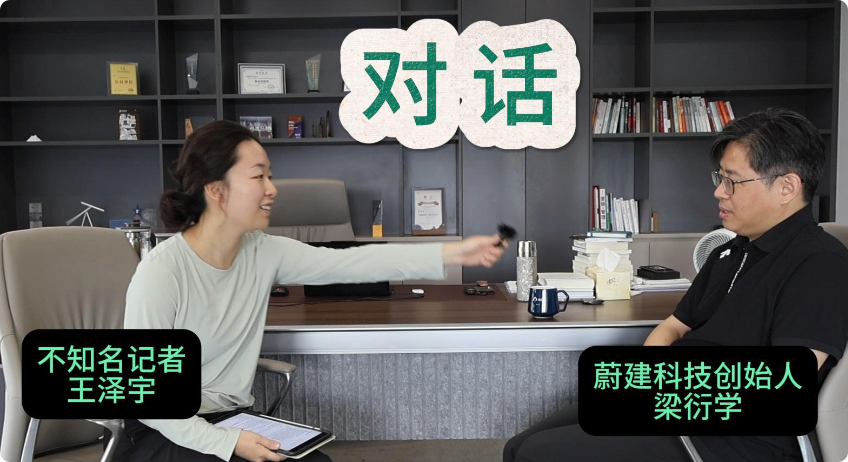
As an outsider, my understanding of construction robots had mostly stayed at a fairly intuitive level: Can machines replace people? How much can they improve efficiency? How quickly can customers earn back their investment?
But what Weibuild showed me was not just a robot that can plaster walls. It was a group of engineers trying to use robotics to rethink an industry that is extremely traditional, extremely complex, and still highly fragmented.
Construction has many problems: labor cost, efficiency, quality, and safety. But one point Liang kept emphasizing was this: the core tension facing construction today may no longer be “will robots take workers’ jobs?” Instead, it may be that fewer and fewer young people are willing to enter construction sites at all.
According to China’s National Bureau of Statistics, the average age of construction workers reached 43.2 in 2024. Workers over 50 accounted for more than 31%, while those aged 21 to 30 made up only around 15%. Construction will not disappear, of course. But the number of people willing to work on construction sites is shrinking. This is already a problem in China. In markets such as Singapore and the Middle East, where construction heavily depends on foreign labor, the problem becomes even sharper.
Weibuild’s most mature product today is its plastering robot.
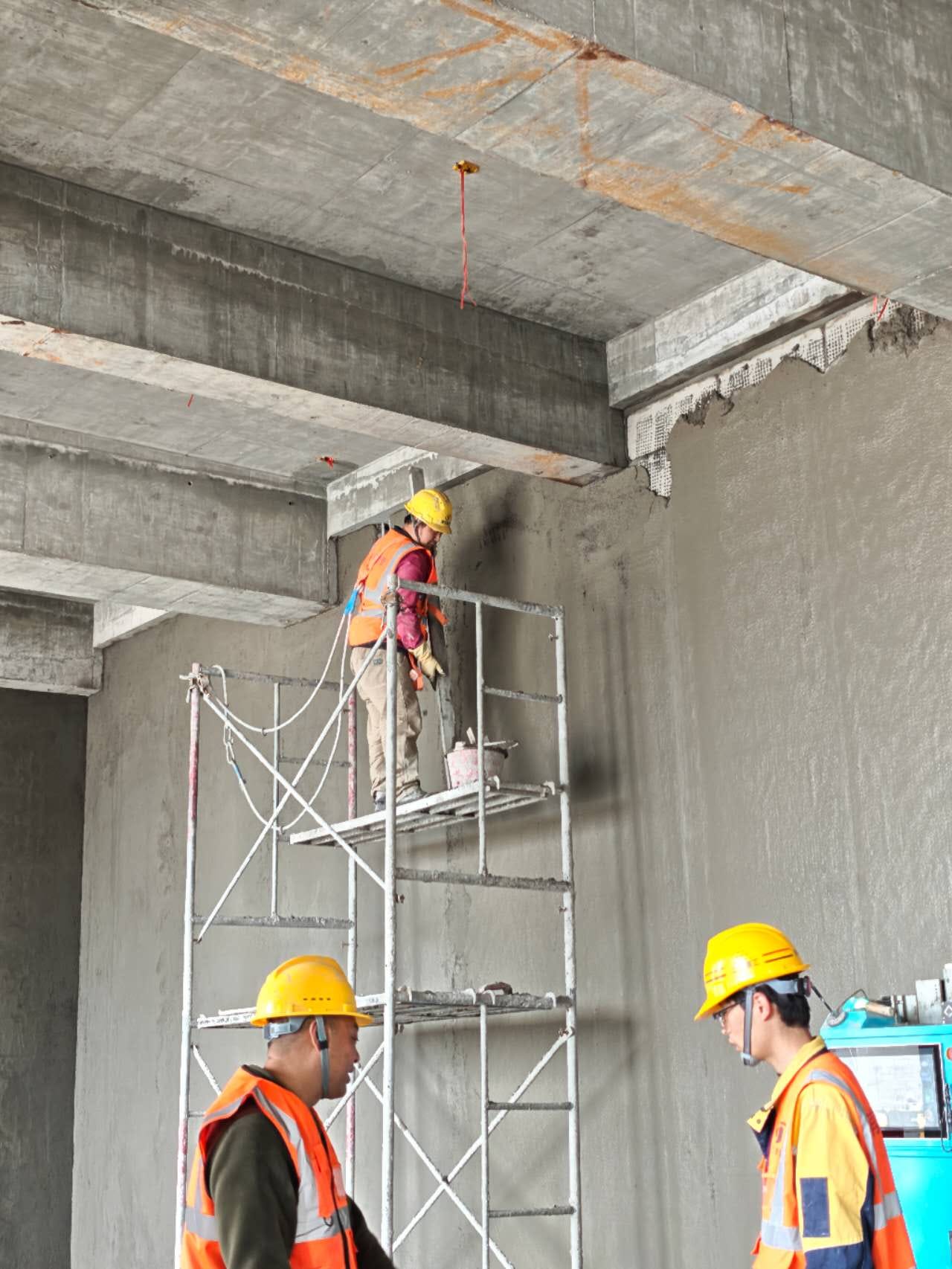
Plastering sounds traditional, but it is precisely one of the most experience-dependent and difficult-to-automate tasks on a construction site. Wall verticality, flatness, plaster thickness, material condition, hollowing rate, edge and corner treatment — every step affects the final delivery quality.
A skilled human plastering worker in China can typically complete around 40 to 50 square meters per day. In overseas markets with stricter quality requirements, that number may drop to 30 square meters or even lower. Weibuild’s plastering robot can complete roughly 300 to 400 square meters in eight hours, with a record of 708 square meters in one day.
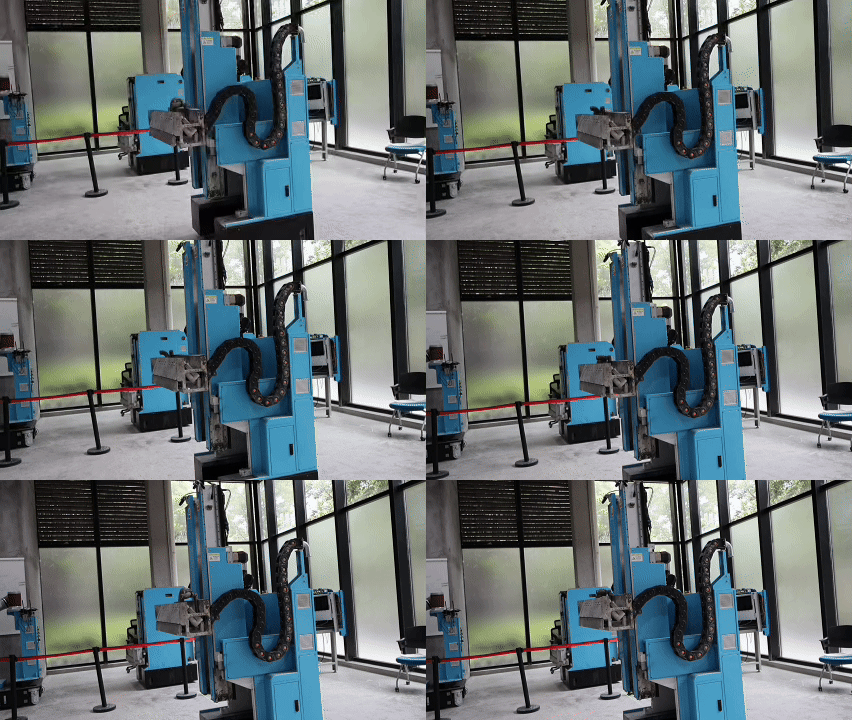
But this machine is not designed to remove humans from the construction site entirely.
A standard operating unit still typically requires one operator, one edge-finishing worker, and one material-feeding worker. The change is that humans no longer stand at the front line of efficiency and quality, using their bodies to complete the most repetitive, dirty, exhausting, and error-prone work. The machine begins to take over those tasks, while the human moves behind the machine and becomes an operator, judge, and coordinator.
That became the most important thread of this interview: what construction robots truly change may not be one single construction process, but the division of labor between “humans” and “machines” in the construction industry.
Quick Q&A: Getting to Know Weibuild
Q: After Weibuild’s latest financing round, what is the company’s approximate valuation?
Liang Yanxue: Around RMB 1.8 billion.
Q: What is the current size of the team? How is it divided among R&D, manufacturing, and sales?
Liang Yanxue: The company has around 150 people in total. R&D is still the core, accounting for around 40%, or roughly 60 to 70 people. Manufacturing has grown quickly this year, because once sales started to pick up, the manufacturing side also had to keep up. The sales team is now close to 20 people. Overseas is still just getting started, and China remains the main market.
Q: Which countries and regions have Weibuild’s robots entered so far?
Liang Yanxue: Singapore, Hong Kong, Taiwan, the Middle East, and Russia. There are also some projects where we followed Chinese clients overseas, such as Jamaica and Honduras in South America.
Q: Which product is currently the most mature and commercially advanced?
Liang Yanxue: The plastering robot. We believe it is currently one of the world’s truly industrialized and commercially deployed autonomous plastering robots. We are not talking about simple mechanical assistance equipment, but a real robot.
Q: How many square meters can one plastering robot complete in a day? How does that compare with human labor?
Liang Yanxue: One machine can complete roughly 300 square meters per day. In terms of performance, it can do 1.2 to 1.5 square meters per minute. The higher the wall, the more efficient it becomes. Human labor is unstable. In China, a worker can do around 40 to 50 square meters a day. In many overseas markets, it may be around 30 square meters. In places with stricter quality requirements, it may even be below 15 square meters.
Q: How many people are usually needed to work with one machine?
Liang Yanxue: At minimum, three people. One operator, one finishing worker, because edges and corners still require manual touch-up, and one person feeding materials. But the material-feeding role already existed before. Whether it is manual work or machine work, someone has to feed materials. So the robot is not simply reducing headcount. It is changing what people do.
Young People Don’t Refuse Construction. They Refuse Traditional Construction.
Q: I saw a set of data showing that the average age of China’s construction workers has exceeded 43. Workers over 50 account for more than 31%, while those aged 21 to 30 account for only around 15%. Why do you think young people are unwilling to enter construction sites? Can construction robots make young people willing to join this industry again?
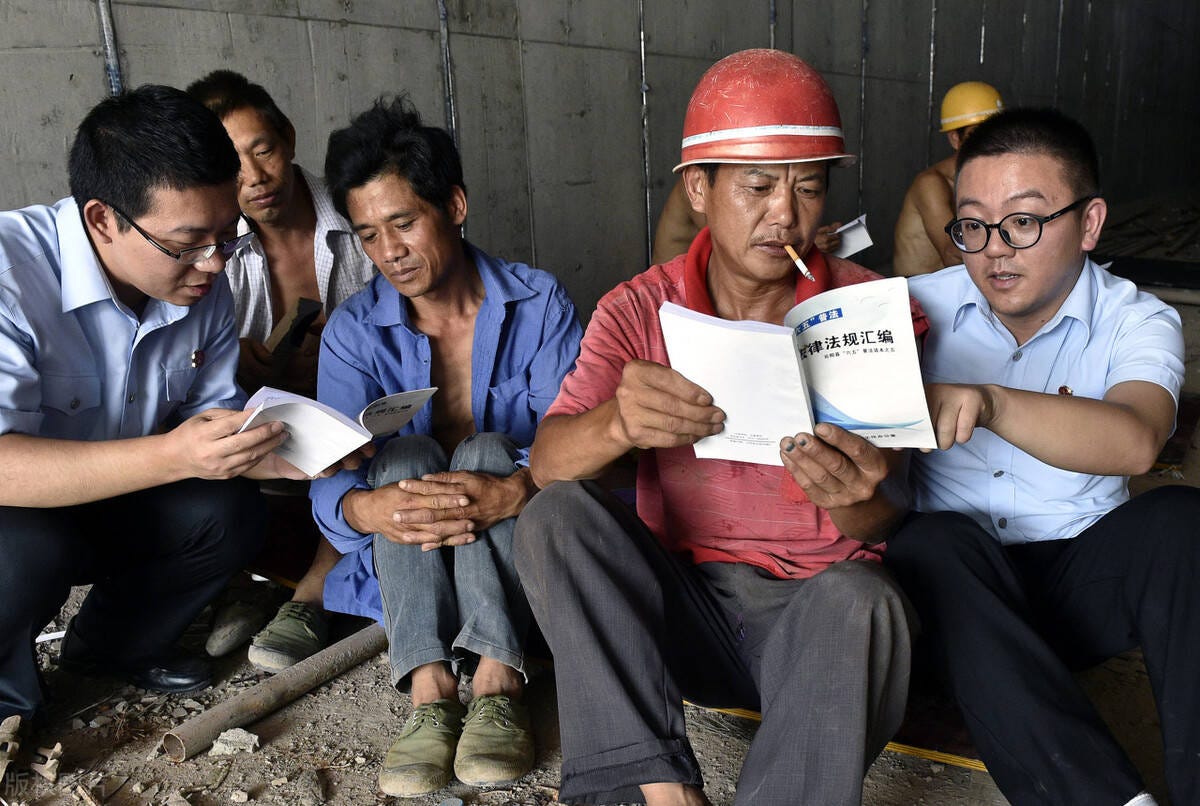
China’s construction workforce is aging. Liang believes that although construction workers often earn more than workers in many other blue-collar jobs, young people hesitate to enter this industry because of a lack of “dignity” or “respectability” associated with the work.
Liang said this is not only a China problem, but a common phenomenon he has observed in many countries and regions: construction will not disappear, and the industry will always need people, but young people are indeed increasingly unwilling to enter construction sites.
He believes one often overlooked factor is occupational pride. A young person may not earn a very high salary in an office, but as long as they walk into an office building in formal clothes every day, they can still feel that their job is respectable. Construction sites are different. Traditional construction workers often leave work covered in mud, dust, and sweat. That condition makes it hard for young people to feel pride in the job.
So when Weibuild develops robots, it is not only calculating efficiency and cost. It is also thinking about the condition of the human standing next to the machine. For example, during plastering, the company tries to reduce material falling and splashing, so workers do not end every day covered in cement. The machine handles the large wall surfaces, while the human maintains and monitors the equipment instead of performing the dirtiest and most exhausting plastering movements directly.
Liang recalled one scene. After visiting one of their construction sites, a chief engineer from a general contractor said that Weibuild’s plastering workers looked like office workers, standing on site with tea cups in their hands. It sounded like a joke, but Liang said this is exactly the direction they want to move toward.
The future construction site he imagines is not a fully unmanned one. It is a site where humans are no longer pressed into the front line of heavy physical labor and quality responsibility. Machines handle efficiency and quality. Humans handle judgment, maintenance, and coordination. Only then, he believes, can construction become attractive to young people again.
Q: So what construction robots really change is not reducing workers, but turning workers into higher-productivity, higher-income technical workers?
Liang’s answer was clear: the latter.
He does not emphasize “unmanned construction.” In his view, a construction site is a typical unstructured environment, very different from a factory. Factory environments are relatively fixed and can be standardized, proceduralized, and formulated. Construction sites change every day. Walls, materials, workflows, and site conditions may all vary. In such an environment, it is impossible to simply pursue full automation.
The more realistic path is to redefine the division of labor between humans and machines. Machines do the simple, heavy, repetitive, and dangerous work, while also taking responsibility for stable quality and efficiency. Humans step away from pure physical labor and move toward judgment, coordination, management, and knowledge-based work.
This is actually similar to the logic of industrial automation. In industry, the main production line is usually centered on machines, while people assist, supervise, and manage machines. Liang believes construction will eventually move in the same direction, though the path will be harder because construction sites are far more complex and unstructured
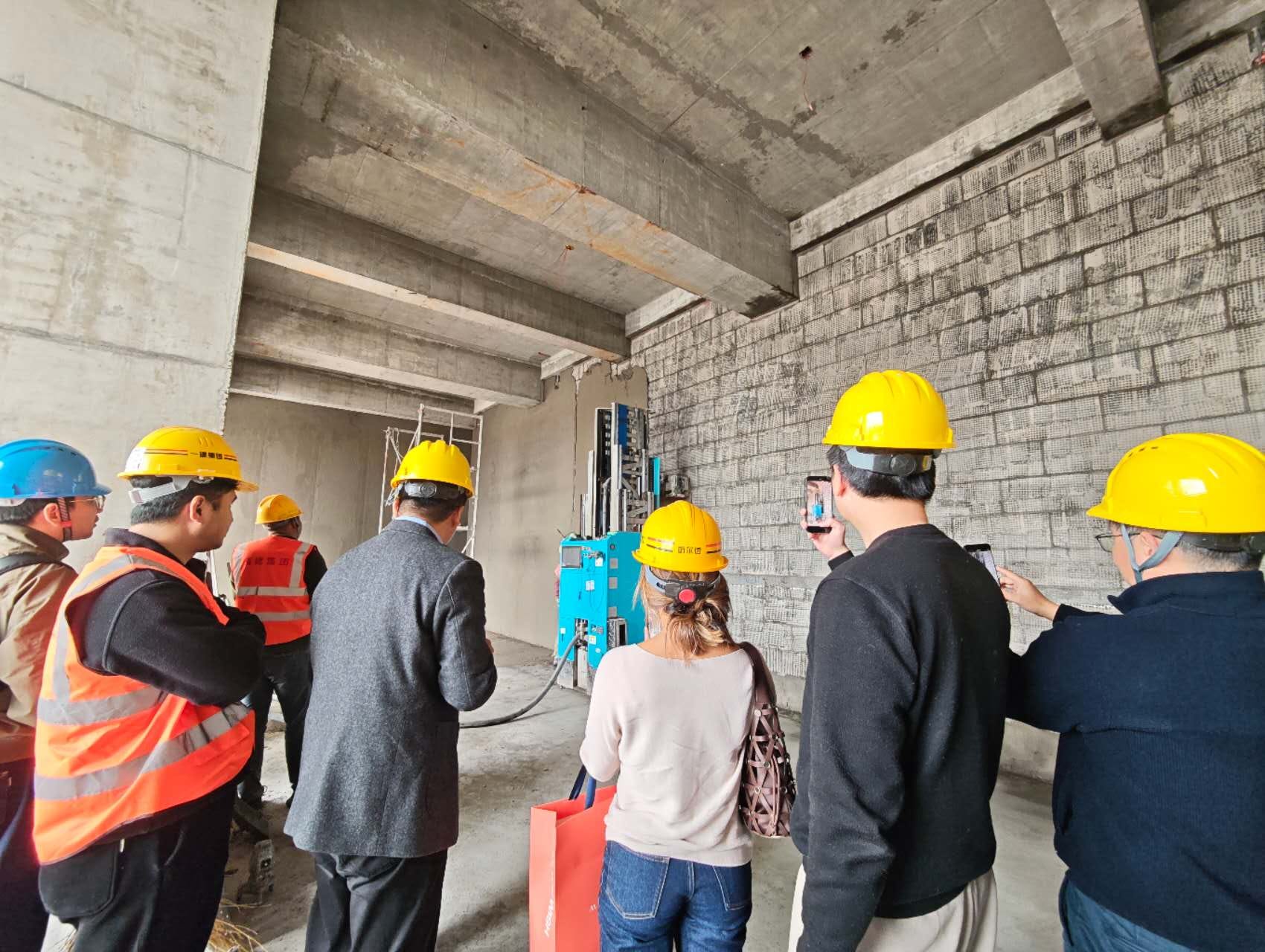
Why Choose Plastering: Not Because It Is Easy, But Because It Is Hard Enough
Q: There are many directions in construction robotics: painting, surveying, tiling, flooring. Why did Weibuild choose plastering first?
Liang said that from the first day of the company, they had been studying what the real pain points in construction were. Plastering is a very typical example of doing something “hard but right.”
What makes plastering difficult? It is not simply about applying mortar to a wall. The machine has to solve an entire process with craft requirements: wall verticality and flatness must be stable, plaster thickness must be controlled, bonding between plaster and wall must be reliable, hollowing must be avoided, large-scale rework must be prevented, and the system has to adapt to different wall types, different materials, different temperatures, and different construction habits.
What makes it even harder is that humans and machines operate according to completely different logic.
When humans plaster walls, they often work backward: apply the plaster first, look at the result, then fix it if it is not good enough, and rework it if necessary. Many traditional construction processes rely on experienced workers making judgments and repairs on site.
Robots cannot work this way. A robot has to follow preset steps and parameters, executing forward: step one, step two, step three. Each step must be correct, and only then can the final result be correct.
If a robot also needs constant rework, then the point of using a robot disappears. So before building the machine, Weibuild had to parameterize plastering itself — breaking down a craft that originally relied on experience into workflows that machines can understand, execute, and verify.
This, Liang believes, is the true difficulty of construction robotics. The difficulty is not only the robot itself, but turning a task that has long depended on humans, experience, and on-site correction into a system that a machine can complete through forward execution.
Q: So the rework rate is actually an important part of the robot’s value?
Yes. Especially in regions where labor is expensive and foreign labor is tightly regulated, rework means reorganizing people, paying labor costs again, and delaying the schedule again. Traditional manual work allows people to “do it first and fix it later,” but every correction means cost. One value of robots is to move that uncertainty forward, stabilizing the process through data, programs, and parameters.
Liang mentioned that a robot is essentially a CNC device. The difference between humans and machines is that humans rely on experience, feel, pressure, speed, and subtle adjustments, while machines rely on data and commands. A robot must be stable and accurate under certain defined conditions, rather than relying on after-the-fact repair. This is why Weibuild has always emphasized quality stability, not only efficiency improvement
The Real Difficulty of Construction Robots Is Construction Itself
Q: What technical difficulties is the plastering robot still trying to overcome?
Liang said that development of the plastering robot began in 2020 and has still not stopped. Once the robot truly entered construction sites, they discovered that the problems were not only in the robot body, but in the entire construction system.
Materials differ from region to region. In China, cement mortar is common, and gypsum mortar is also used. But gypsum mortar hardens easily and places different requirements on the construction system. In the Middle East, many materials come in bags, unlike in China where many projects use large mortar tanks that deliver material directly to the floor. On-site mixing systems and feeding systems are different. This means Weibuild cannot just build a plastering robot; it also has to extend into surrounding equipment, including feeding and mixing systems.
Liang said that if robot efficiency does not improve, customers will not think it is because of material problems or feeding problems. They will think it is the robot’s problem. Because what customers are buying is a new construction path, not an isolated piece of equipment. So Weibuild has to look at the whole system, not only the single machine.
There is also a more fundamental problem: the precision of construction itself is unstable. Many people assume that robots can simply follow national standards. But real construction sites do not always work that way. Theoretical wall standards may not be met in real conditions. If a robot is designed strictly according to an ideal environment, it will enter the site and “run headfirst into the wall,” so to speak.
This is why Weibuild’s plastering robot still leaves edges and corners to humans for now. It is not because machines will never be able to do those parts. It is because, at this stage, machines still need to coexist with a construction site that is not fully standardized.
Liang also mentioned that Weibuild is developing a bricklaying robot. The reason is straightforward: if future walls are built by machines, then the plastering robot can work on a more stable and trustworthy wall surface. Machines can establish precision trust with other machines. That trust is much harder to establish between machines and humans today.
In other words, a single robot is only the beginning. The real efficiency improvement comes from continuity across multiple processes. When bricklaying, plastering, and painting are gradually robotized, construction sites will move from isolated single-point improvements toward systematic reconstruction.
Why Overseas Markets Are More Urgent: Foreign Labor, Labor Cost, and Organizational Cost
Q: In markets such as Singapore and the Middle East, which depend heavily on foreign labor, are construction robots easier to accept?
Liang believes the demand overseas is very direct. Many countries and regions are heavily dependent on foreign labor. Recruitment, management, compliance, training, and worker mobility all create high social and organizational costs. Singapore and the Middle East are especially typical: labor is not only expensive, but also not something you can use without limit.
In this context, the value of robots is not just replacing the hourly wage of one worker. It is reducing the complexity of the entire construction organization. Traditional construction requires many different skilled workers, who need to appear at the right construction site at the right time while maintaining consistent quality. Whenever rework happens, it means reorganizing people, rescheduling the project, and paying costs again.
If one person can operate several different machines across multiple processes after two or three weeks of training, then the change is not only “several times higher efficiency.” It means the entire project organization becomes lighter

Liang mentioned that in countries heavily dependent on foreign labor, if a task that previously required more than 30 skilled workers can now be completed partly through robots and a small number of trained operators, then social organizational costs may drop significantly. The value here is not linear, but cumulative: robotizing one process has value, but robotizing multiple continuous processes amplifies that value.
This also explains why Weibuild places importance on the Middle East and Singapore. In these markets, labor constraints, quality requirements, schedule pressure, and rework costs all exist at the same time. Robots are not a “nice-to-have” tool; they may become a more economical way to organize construction.
Will the Real Estate Downturn Affect Construction Robots?
Q: Many investors immediately associate “construction robots” with the real estate downturn. In 2025, China’s real estate development investment, new construction starts, residential new starts, and commercial housing sales area were all declining. How do you view this concern? Will construction robots be affected by the real estate cycle?
Liang does not agree with this judgment. His first reaction was: “It is far from affecting us.”
His logic has two layers.
First, real estate is not equal to construction. Real estate is only one type of construction. Construction also includes a large amount of infrastructure, public buildings, industrial buildings, overseas projects, and renovation. Using the real estate cycle to judge the entire construction robotics industry is, in his view, “using something macro to look at something very micro.”
Second, even if real estate-related data is declining, the market base is still far larger than what Weibuild can currently cover. Liang said that the construction area numbers published by the National Bureau of Statistics are already two or three orders of magnitude larger than Weibuild’s current delivery capacity. Weibuild’s engineering team has completed only a few million square meters over the past few years, and within China’s overall construction market, its coverage may not even reach 0.1%, or perhaps even less.
He said Weibuild has barely done any real estate work so far. For them, what truly matters is not whether the macro market declines by a few percentage points, but whether their technology can meet customer requirements and offer a better construction method. As long as robots can unlock even a tiny portion of demand in a massive market, that is already large enough for a startup.
This answer is interesting. It does not simply deny the cycle. Instead, it shifts the question from “is the real estate market still okay?” to “how early is the penetration of a new technology in a massive traditional industry?” When penetration is still negligible, macro decline may affect industry sentiment, but it may not determine the growth ceiling of an individual company.
Weibuild Does Not Only Want to Build Construction Robots
Q: So construction is only Weibuild’s first scenario, not the final destination?
Liang said that from the beginning, Weibuild did not want to build “construction robots” in the narrow sense. Their earlier expression was: “robots that can walk and work.”
Here, “work” does not mean moving something from point A to point B. It means performing tasks with process and quality requirements. In other words, the robot must complete quality-standardized work in unstructured environments.
Construction is a good starting point because it is large enough, certain enough, and painful enough. It has many high-value processes that still rely heavily on labor, and it has sufficiently complex site conditions that force the technology to truly land. Liang even believes that if robots can work in an unstructured, low-standardization environment like construction, then entering many industrial scenarios later may actually be easier.
He gave an example: industrial automation is already highly developed, but China’s industrial sector still employs a large number of people, because not all work can be solved by assembly lines. For example, large wind turbine blades can be more than 100 meters long and several meters in diameter. Painting, sanding, and inspection are difficult to put onto a standard assembly line and still require large amounts of labor. These large-scale, non-standard industrial tasks with process requirements are, in essence, similar to construction sites.
So what Weibuild is accumulating today on construction sites is not just the act of plastering. It is the capability for mobile robots to complete complex process work in unstructured environments. This capability can later migrate to more scenarios.
In other words, construction is the first hard bone Weibuild chose to chew on. It is not the last one.
Doing the “Hard but Right” Thing
Q: From starting plastering robot development in 2020 to delivering so many projects today, what has been your biggest takeaway?
Liang said R&D has never stopped. A plastering robot is not a product that is finished once it is built. It evolves from “being able to put plaster on the wall,” to “being able to plaster stably and well,” to “being able to adapt to different materials, regions, and processes.” Every step is difficult.
He recalled an early scene: the first time they built a working prototype in the lab, ten people were serving one machine, and the result was not even as good as a human worker doing it directly. If investors had seen it at that time, many probably would not have invested. But a real pain point often does not require a product to reach 100 points before customers are willing to buy. Sometimes, when you reach 20 or 30 points, customers are already willing to try it.
That proves the demand is real.
Liang said that if a product must reach 100 points before customers buy it, then perhaps customers do not really need it that much. But if customers are willing to use it when it is only at 30 points, that means the pain is real. Plastering robots are exactly such a case.
That is also why he says entrepreneurship should focus on doing the “hard but right” things. Easy scenarios are often already crowded, and many people can do them. The reason truly painful problems remain unsolved for so long is often precisely because they are hard. Weibuild chose plastering not because it was easy to commercialize, but because the process was difficult enough, painful enough, and valuable enough to prove the role of robots on construction sites.
After the Interview
After this conversation, my understanding of construction robots changed.
This is not a simple “machines replacing people” story.
Nor is it a small tool tied to the real estate cycle.
More accurately, it feels like construction work is being re-organized: machines take on stable, repetitive, dangerous, and physically intensive process work; humans step back from the dirty, exhausting, and risky front line and become the people who operate machines, judge site conditions, and manage quality.
If this direction holds, construction robots may eventually change not only efficiency, but the talent structure, cost structure, and organizational model of the construction industry.
The construction site of the future may not become fully unmanned.
But it will almost certainly look very different from the construction site we know today.